
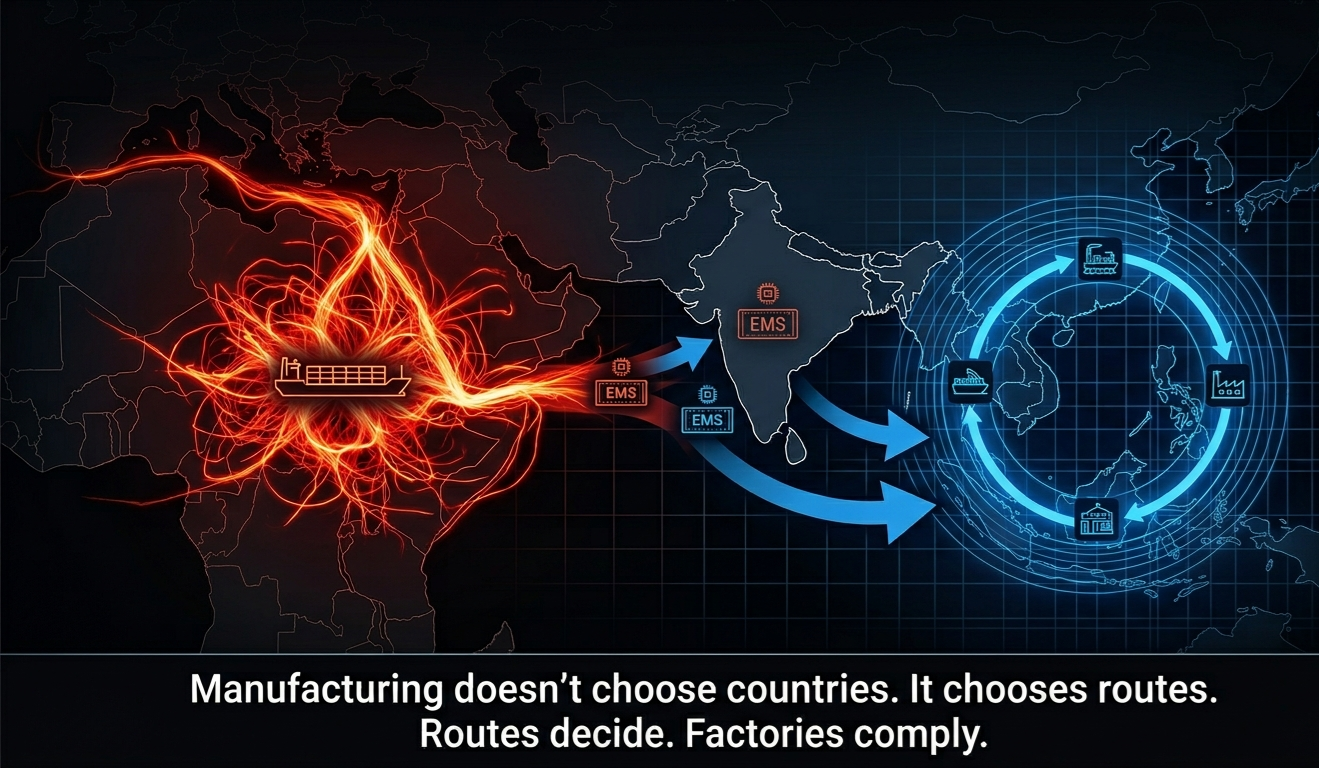
Manufacturing doesn’t choose countries. It chooses routes. Routes decide. Factories comply.
Issue 4 · Strategy Series
The Corridor Problem
A series on logistics, allocation, and India’s manufacturing future
Doctrine of the Industrial Stack
Read →The 2–3% That Broke PLI Math
Read →Where the Contracts Went
Read →Miss the Window. Lose the Load.
You are hereIndia and Systems of Scale
Read →Corridor Gap Closed
Read →Corridor > Country
Policy talks countries.
Manufacturing runs corridors.
Lowest cost doesn’t win.
The route that holds does.
China+1 is a map.
Buyers don’t use maps.
They use delivery windows.
Factories follow routes. Not flags.
Where the Load Went
Allocation didn’t disappear.
It moved.
Suez got noisy. Transit broke. Insurance repriced risk.
Orders shifted.
No calls. No meetings.
The next cycle used a different route.
The System
Three routes are taking the load.
Coastal Routes
10–14 days
Port and factory move together.
Low variance.
Hybrid Routes
Rail + Sea
Costs more.
Lands on time.
Chokepoint Routes
Long Haul
Insurance moves daily.
Arrival isn’t guaranteed.
Orders are leaving.
Route Logic
Contracts don’t wait for meetings.
The Threshold
Delivery slips. Allocation moves.
Two bad cycles. Route changes.
Three. Supplier is out.
Buyers pay for certainty.
India
India can build.
India can’t route.
The factory works.
The corridor doesn’t.
You can’t scale exports on a route that reprices overnight.
That’s the constraint.
The Pivot
INSTC cuts the risk.
Sea risk becomes land route.
Transit locks into a window.
Variance drops.
That’s what holds contracts.
Delays kill more than cost.
Five days late costs more than five percent extra.
Stable beats cheap.
Once a route takes the load, it keeps it.
Routes decide. Factories comply.
The Corridor Problem — 4-Part Series
A series on logistics, allocation, and India’s manufacturing future