India Can Now See Where Enterprise Becomes Productivity
Existing district programmes now need a common productivity account.
12 September 2026

Upfront
BHAVYA Rasayan will spend ₹3,000 crore on common infrastructure across three chemical parks. Their advantage will depend on binding performance standards, funded operating readiness and one accountable authority.
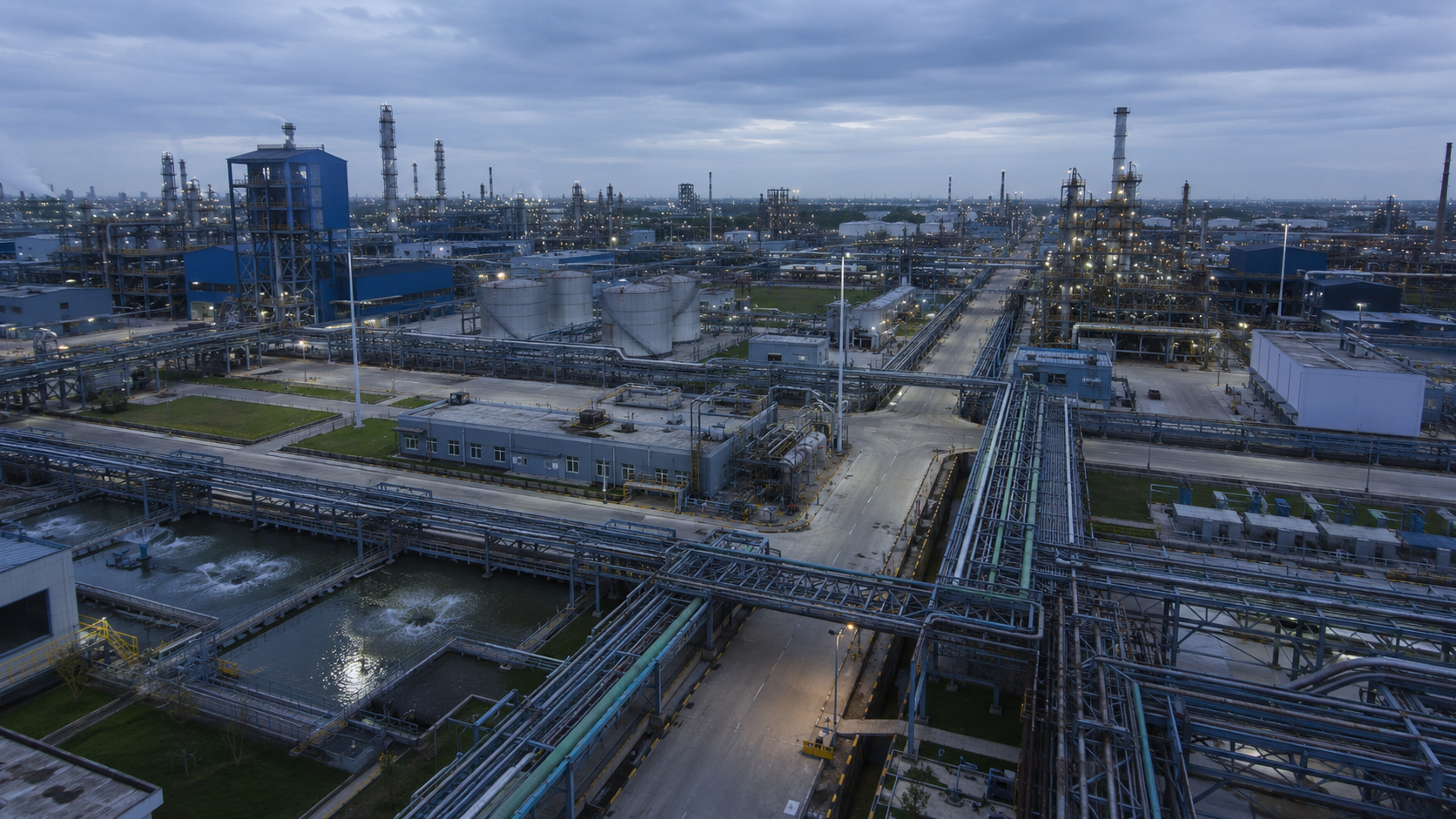
INSIDE A CHEMICAL PARK, the factory boundary is deceptive. A tenant may own its reactors and process chemistry while depending on steam, water, effluent treatment, pipelines and emergency response beyond its control. A fault in that common system enters the factory as higher cost, lost output, regulatory exposure or a broken delivery promise.
BHAVYA Rasayan recognises this dependency. Chemicals feed agriculture, pharmaceuticals, textiles and electronics; weakness inside the park therefore travels through the wider economy. In March, the Chemicals Minister set a broader ambition for the sector: raise India's global share from 3% to 5–6% by 2030 and its turnover to $1 trillion by 2040. That scale will depend on infrastructure that performs continuously.
Of the scheme's ₹3,030 crore outlay, ₹3,000 crore is directed towards common infrastructure and basic utilities. The list includes the common effluent treatment plant (CETP), hazardous-waste handling, water networks, solvent recovery, steam, pipelines and logistics. These assets serve every tenant while belonging to no individual production line.
The Centre may provide up to ₹1,000 crore per park, subject to a minimum state contribution of ₹500 crore. At the Cabinet briefing, the government estimated that each site could attract ₹20,000–50,000 crore in investment. Public capital will therefore shape industrial investment many times its own size.
Its reach also stops at a defined boundary. The Cabinet release confines the Central grant to common infrastructure inside the park. It identifies no funding for land or for any external roads, rail links, transmission capacity and water-source development needed to connect a selected site to the wider industrial network.
The release is detailed about assets and silent about operating authority. It does not say who will run the CETP, steam network and pipelines, how tariffs will be set, or what performance tenants will be entitled to demand. Construction can deliver physical capacity. Industrial advantage appears only when that capacity holds its pressure, quality, price and response time.
Doctrine
Occupancy makes the first years especially difficult. Common utilities begin with the fixed costs of an industrial system built for eventual scale, while demand may come from only a handful of tenants. Recover the full cost from those early manufacturers and the park penalises the companies that arrive first. Hold tariffs below cost without funded support and maintenance comes under pressure.
A time-bound ramp-up mechanism should absorb that mismatch while utilisation builds. Anchor-tenant capacity commitments, phased commissioning and declining availability payments tied to performance offer possible routes. Support should recede as demand rises. The state must underwrite readiness without permanently underwriting inefficiency.
Failure exposes the harder question: operational authority. A chemical incident cannot wait for jurisdiction to be reconciled across the park developer, utility contractors, regulators, fire services, district administration and individual factories. During a CETP breakdown or pipeline leak, institutional boundaries offer no protection to workers, neighbouring plants or nearby settlements.
Administrative responsibility may remain distributed. Operational authority cannot. Before production begins, one body must hold the mandate to direct fire response, evacuation, medical care and public communication across the site. It must also possess the power to compel action from every service provider. Liability for failure in a common facility should be assigned before the first incident. A system trusted by manufacturers must also be trusted by the people living around it.
CHEMPARK in Germany provides the clearest benchmark for operating depth. Currenta combines utilities with maintenance, logistics, fire and rescue, environmental control and emergency medicine. At Shanghai Chemical Industry Park, responsibility continues beyond development into operation and tenant services. Jurong Island takes another route: several specialist providers work within integrated masterplanning, shared utilities and pipeline infrastructure.
India need not reproduce any one corporate form. The transferable element is unified operational authority: an institution able to bind every provider to the park's standard and act without assembling consent during failure.
That authority is difficult to locate in the present Indian arrangement. Central funding enters through the scheme; land and development sit with states; environmental jurisdiction rests with pollution-control bodies; individual utilities may be contracted separately. Every institution can fulfil its formal mandate while the park still fails as an operating system.
Construction distributes contracts and political credit across many hands. Accountable operation concentrates authority, liability and blame. That is administratively harder. A breakdown demands an authority able to direct providers immediately, disclose performance, allocate liability and answer for the outcome.
Before commissioning, each park should publish an operating compact. It should identify the operational authority, establish utility and treatment standards, set transparent tariff rules, create a maintenance reserve and disclose operating and environmental performance. Tenant entry should follow only after that authority is executable.
BHAVYA Rasayan already contains the physical architecture. The unfinished work is the operating order around it. Acreage and capital announcements will record construction. Uptime, treatment performance, tenant costs, commissioning speed and recovery from failure will reveal whether the parks have become industrial systems.
India will know whether BHAVYA Rasayan succeeded when manufacturers depend on the shared layer without having to compensate for its weakness.
More from Upfront
Existing district programmes now need a common productivity account.
12 September 2026

India’s bid to move from 10 to 50 companies in the Global 500 needs a route to clear government-side blockages without shifting commercial risk to the state.
8 September 2026

India should map its future machinery demand early enough for domestic suppliers to develop, qualify and compete before procurement begins.
3 September 2026
Rule 5 should become a bankable Project Development Approval that states who decides each regulatory, site and commercial question, how and by when.
1 September 2026