
India Can Now See Where Enterprise Becomes Productivity
Existing district programmes now need a common productivity account.
12 September 2026

Upfront
Gwalior will house specialised laboratories across India's telecom technology stack. The decisive test is whether they can carry a domestic product from prototype through certification, interoperability and its first operator-approved deployment.
Doctrine
ON JULY 30, the Department of Telecommunications and the Government of Madhya Pradesh signed the MoU for India's first integrated Telecom Manufacturing Zone in Gwalior. Phase I carries ₹493 crore in central support and will be governed by a special purpose vehicle split 51% Madhya Pradesh and 49% DoT. The plan lists facilities for 5G core, satellite communications, optical fibre, SIM technologies, passive optical networks, routers and cybersecurity.
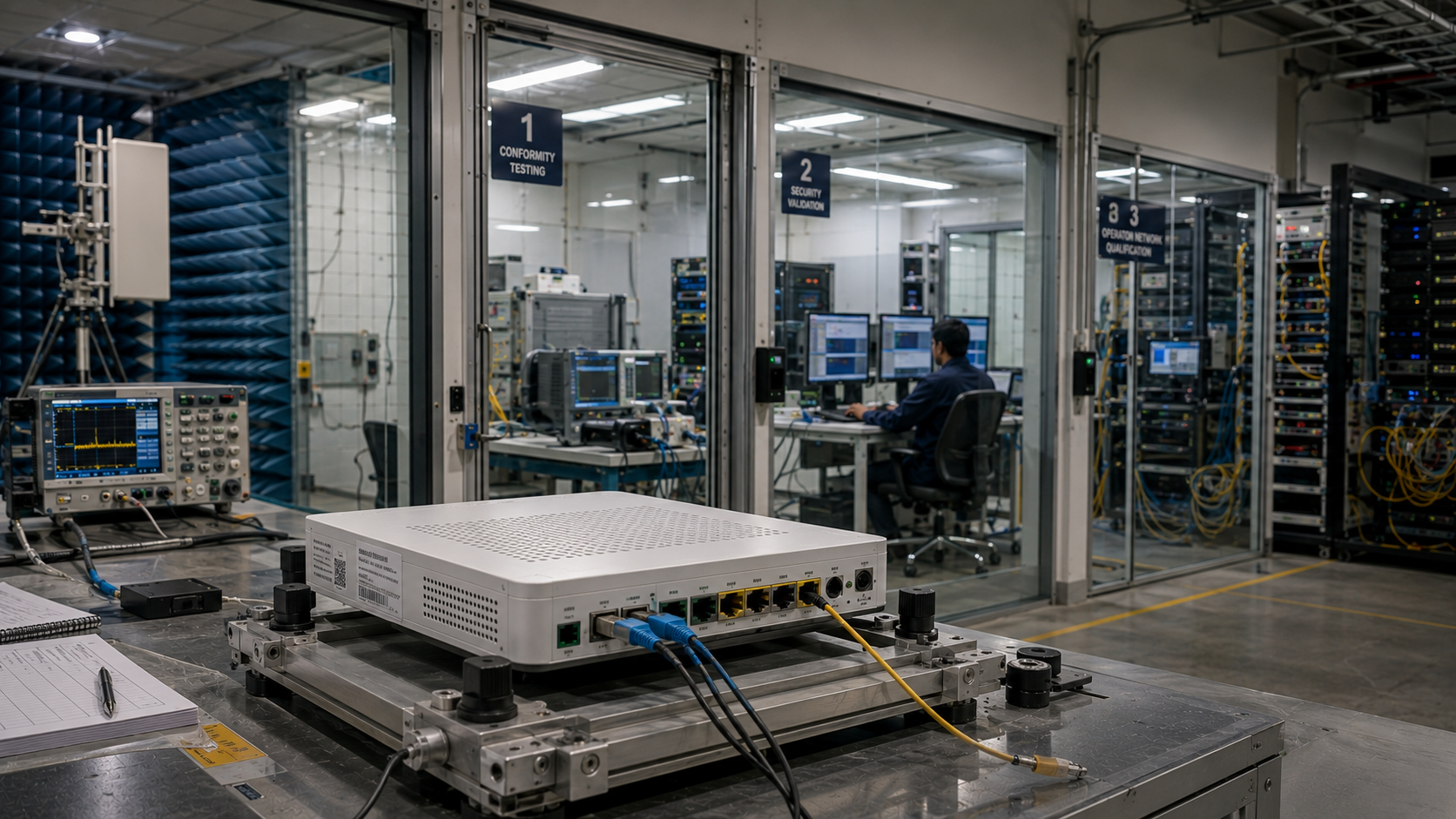
That list carries a warning. Telecom equipment cannot move directly from assembly line to customer. It must cross several systems of proof. The measure of Gwalior will be a finished telecom product entering a commercial network, not another completed laboratory.
Three gates stand between a working prototype and a paying network. Under MTCTE, TEC issues the statutory conformity certificate required before notified equipment can be sold or used in India. Where security certification applies, NCCS runs a separate assurance process through designated laboratories. Neither settles the final gate. An operator must still test interoperability and field performance inside its own network before it buys.
A certificate makes equipment eligible for deployment. It cannot compel an operator to accept the integration risk.
No institution is responsible for moving a domestic prototype to its first operator-approved deployment. Formal approval is distributed across TEC, NCCS and designated laboratories. Even after those requirements are cleared, an operator must decide whether to accept the technical and operational risk of a new supplier in its live network. A product can satisfy every mandated test and still remain commercially stranded.
Consider a small Indian manufacturer of an optical network terminal. It clears electrical, electromagnetic and technical conformity before entering security testing. A software revision can reopen evidence already produced. The product must then work with an operator's installed systems and field conditions.
No operator wants to become the first deployment. Without one, the manufacturer cannot build the field record buyers demand. Fee cuts and the extended Pro Tem security route—under which 107 certificates had been issued—ease immediate pressure. They do not resolve the wait at the buyer's gate.
Other systems have recognised parts of this friction. The O-RAN Alliance's certification and badging programme tests common requirements once, reducing repetition during later operator evaluation. Britain's four-year SONIC Labs programme linked vendor-neutral interoperability testing to deployment readiness before it concluded this year. Germany's i14y Lab works further upstream, helping suppliers detect engineering failures before formal certification. Gwalior need not copy any of them. In each case, testing remains connected to the engineering or deployment decision that follows.
The Gwalior SPV should own a Product Qualification Corridor from pre-compliance through certification, security assurance, interoperability and first deployment. DoT should designate the SPV as programme manager. Operators would participate through test-bed and field-validation agreements. TEC and NCCS would retain every statutory decision.
Before testing begins, the SPV would assemble one qualification plan covering sequence, evidence, liability and retesting triggers. Evidence against an identical requirement would carry forward unless a later gate identifies a materially different risk. A limited BSNL field-validation window could give a qualified supplier its first network record, with deployment limits and liability fixed in advance and no guaranteed order.
Institutional fragmentation keeps the product stranded. Regulators must protect conformity and security. Operators must control network risk. A small manufacturer cannot finance the coordination missing between them. It can run out of capital before it runs out of merit.
Gwalior's progress reports will list factories, laboratories, investment and jobs. Those figures will not reveal whether an Indian telecom product reached a live network. The SPV's industrial record is the number of domestic products it carries through qualification into commercial networks—and the time each one takes.
More from Upfront
Existing district programmes now need a common productivity account.
12 September 2026

India’s bid to move from 10 to 50 companies in the Global 500 needs a route to clear government-side blockages without shifting commercial risk to the state.
8 September 2026
India should map its future machinery demand early enough for domestic suppliers to develop, qualify and compete before procurement begins.
3 September 2026

Rule 5 should become a bankable Project Development Approval that states who decides each regulatory, site and commercial question, how and by when.
1 September 2026